Véronique Béland ‑ cocréation avec Julie Hétu
Tiohtià:ke/Mooniyang/Montréal
L’archéosténographe
Une machine à écrire préhistorique générant des mythes du futur
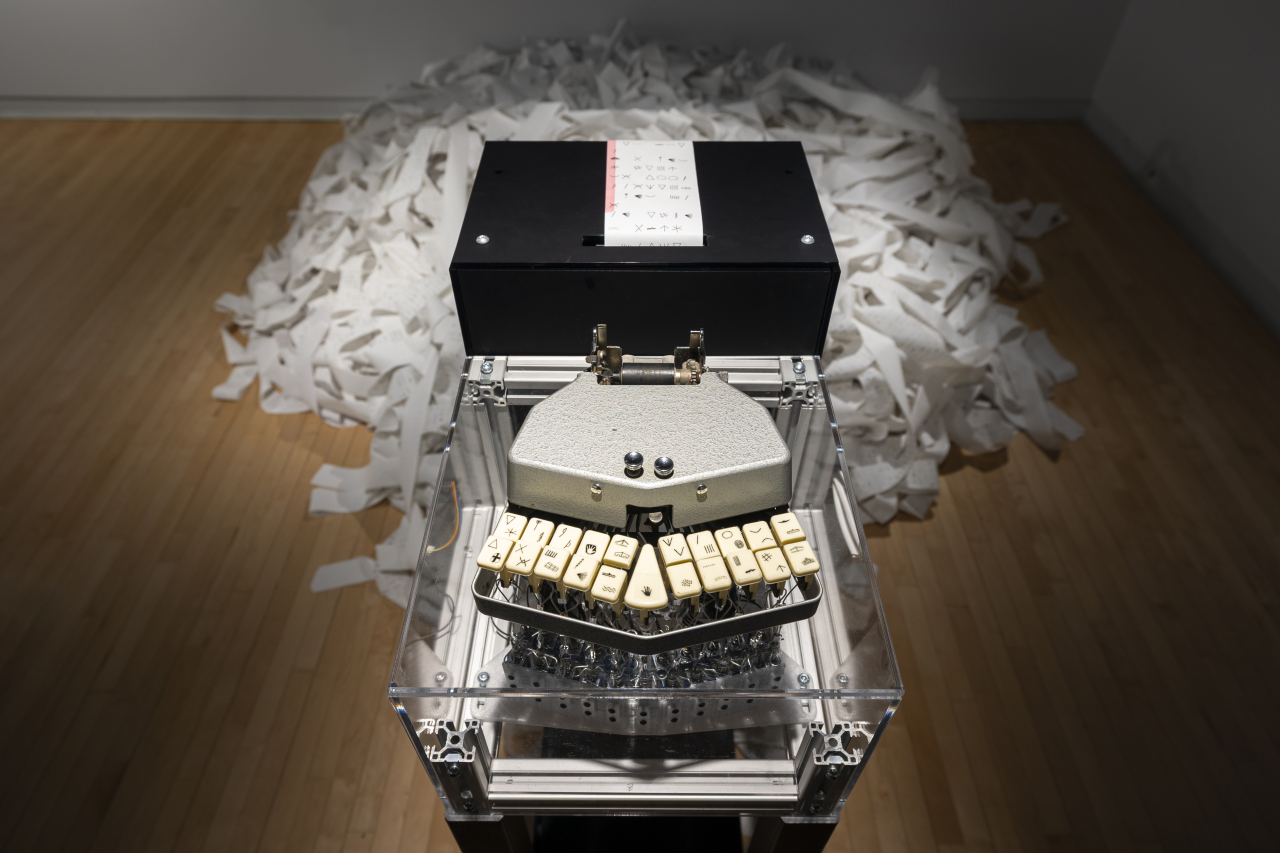
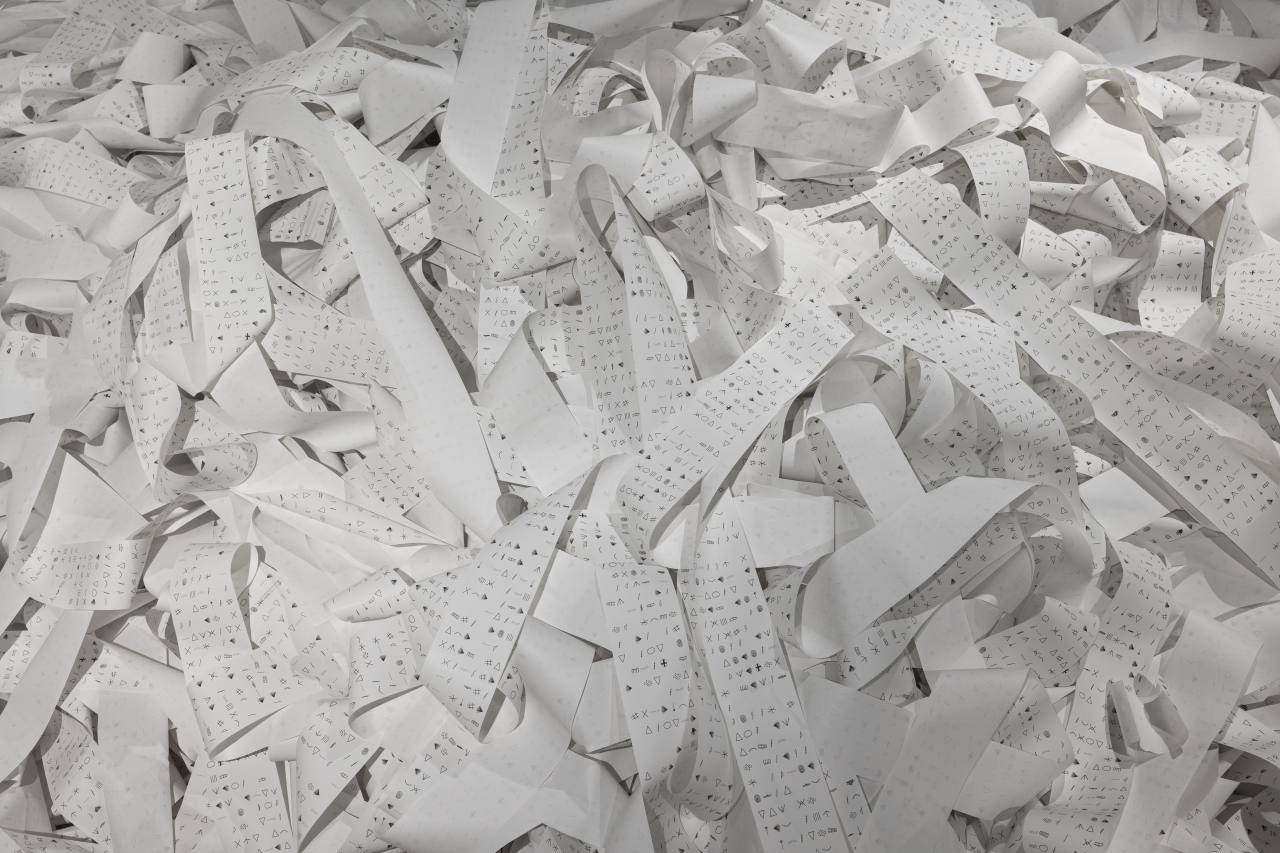
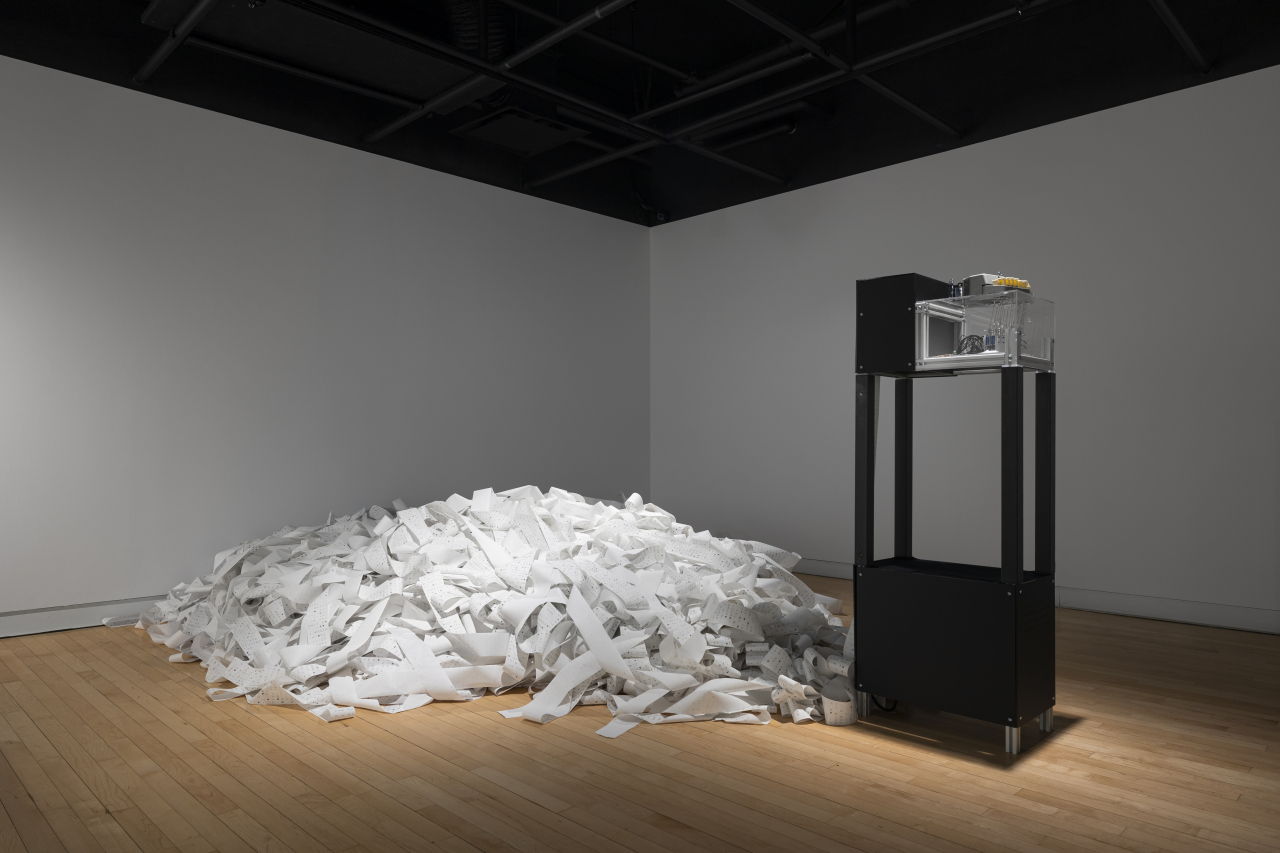
L’installation générative L’archéosténographe met en scène une intelligence artificielle entraînée à inventer des mythes sur le futur de l’humanité, qu’elle restitue à l’aide d’une voix de synthèse. Ces récits sont simultanément transcrits par une sténotype – une machine à écrire phonétique – en une multitude de signes inspirés de l’art pariétal, transformant la parole en trace visuelle.
Conçue à partir d’une grammaire développée par Julie Hétu, L’archéosténographe associe les 36 phonèmes de la langue française à des symboles paléolithiques issus des premières formes d’abstraction humaine. L’installation croise ainsi traditions orales et écritures premières, mettant en dialogue technologies contemporaines et gestes archaïques.
Le système repose sur un réseau de neurones artificiels nourri de mythes fondateurs provenant de cultures du monde entier. En s’appuyant sur ces récits anciens pour imaginer l’avenir, l’intelligence artificielle produit des narrations inédites, orientées vers des issues ouvertes et non dystopiques.
L’œuvre s’inscrit dans un geste poétique évoquant à la fois de grandes découvertes, comme la pierre de Rosette ayant permis le déchiffrement des hiéroglyphes, et un désir profondément humain et ancestral : celui de préserver les récits, y compris ceux qui n’existent pas encore.
Véronique Béland mêle arts médiatiques et littérature pour interroger la machine comme entité créatrice et les phénomènes imperceptibles à échelle humaine. En s’appuyant sur les langages du numérique et l’intelligence artificielle, elle conçoit des dispositifs qui, bien que dénués d’intelligence propre, engendrent un imaginaire singulier (par exemple : S’affranchir – le poids des mots, 2025 ; En sortie, le scientifique de l’espace, 2022 ; Haunted Telegraph, 2020 ; Mécanique d’évaporation des rêves, 2018). Par des protocoles de traduction entre art, science et archivage, ses œuvres ouvrent un espace alternatif de narration et de perception du monde.
Julie Hétu est une autrice et scénariste dont les œuvres sont influencées par ses recherches en anthropologie. Elle se passionne pour les différentes façons d’écrire et les premières écritures. Elle a notamment écrit L’écrivain préhistorique. Naissance du chant et de l’écriture dans la préhistoire
(2020, éditions Nota bene), fruit de ses recherches dans la grotte de Niaux.
A Prehistoric Typewriter Generating Myths About the Future
The Archaeostenographer is a generative installation that features an artificial intelligence trained to invent myths about the future of humankind, which it delivers in a synthesized voice. These narratives are simultaneously transcribed by a stenotype – a phonetic typewriter – into a multitude of symbols inspired by cave art, transforming speech into a visual trace.
Designed using a grammar developed by Julie Hétu, the installation associates the 36 phonemes of the French language with Paleolithic symbols derived from the earliest forms of human abstraction. This way, it intertwines oral traditions and early writings, creating a dialogue between contemporary technologies and archaic gestures.
The system is based on an artificial neural network fed with foundational myths from cultures around the world. By drawing on these ancient tales to imagine the future, artificial intelligence produces new narratives, oriented towards open, non-dystopian outcomes.
The work is part of a poetic approach evoking both great discoveries, such as the Rosetta Stone, which enabled the deciphering of hieroglyphs, and a deeply human and ancestral desire: that of preserving stories, including those that have yet to come.
Véronique Béland blends media arts and literature to question the machine as a creative entity and phenomena imperceptible on a human scale. By relying on digital languages and artificial intelligence, she designs devices which, although devoid of their own intelligence, generate a unique imaginary world (for example: The Weight of Words, 2025; On the Way Out, the Space Scientist: Update on the Conception Process, 2022; Haunted Telegraph, 2020; The Mechanics of Dream Evaporation, 2018). Through translation protocols between art, science and archiving, her works open up an alternative space for narration and perception of the world.
Julie Hétu is an author and screenwriter whose works are influenced by her research in anthropology. She is passionate about different ways of writing and early forms of writing. In particular, she wrote L’écrivain préhistorique. Naissance du chant et de l’écriture dans la préhistoire (2020, publisher: Nota bene), the result of her research in the Niaux cave.
Conception et réalisation : Véronique Béland et Julie Hétu
Programmation informatique : Léo Dubus
Conception mécatronique : Quentin Deyna
Ce projet est soutenu par le Conseil des arts du Canada.
Design and production: Véronique Béland and Julie Hétu
Computer programming: Léo Dubus
Mechatronics design: Quentin Deyna
This project is supported by the Canada Council for the Arts.
Portrait : Chantale Lecours
Images : Étienne Boisvert